Inicio › Ordenadores › Fujitsu-FM7

Fujitsu-FM7

💾 Ordenadores5 fichas
más de Fujitsu

Máquinas (1–5 de 5)

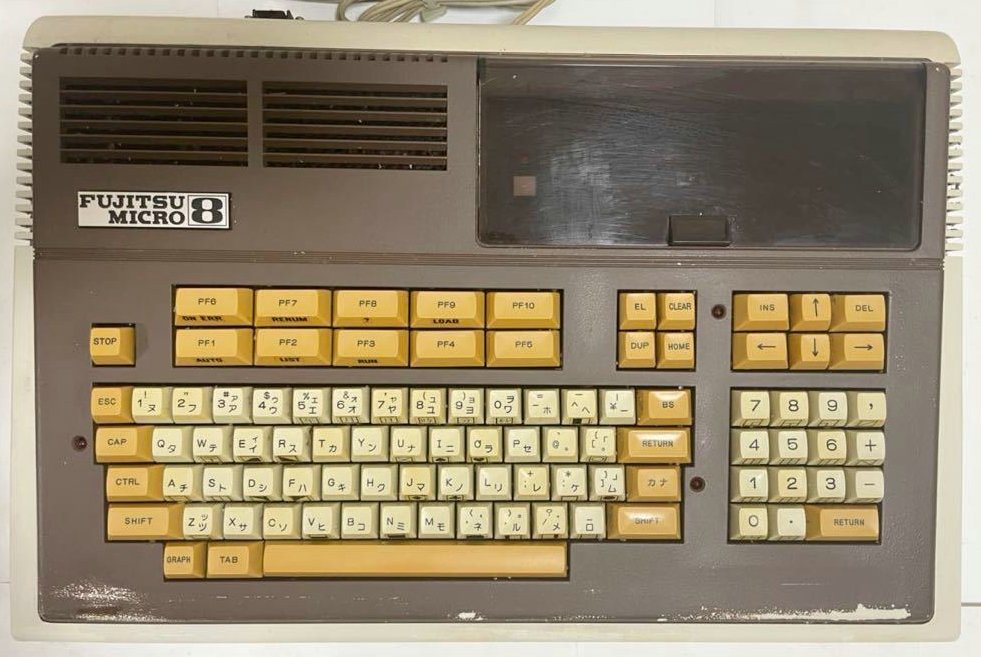
Fujitsu Micro 8
Fujitsu Micro 8
📅 1981🌍 Japon
💶 31/07/15-80,06/10/15-100,01/12/15-82
Ficha técnica

Historia

Introduced may 1981, the FM 8 was one of the first Fujitsu micro computers (after the LKIT-8 hobby computer in 1977). In any case it was the first member of the FM series, FM standing for Fujitsu Micro. At that time its features were really impressive: bi-processor (even an additionnal Z80 cpu could be installed), 64 KB RAM, bubble memory, built-in chinese characters ROM, 640x200 high resolution with 8 colors and no proximity conflict! The FM-8 was developed by employing innovative design and state-of-the-art semiconductor technology, and was designed for use in a variety of fields, ranging from high-level hobby use, to business applications and process control. The Japanese Computer Museum specifies: The FM-8 had the following features: - Equipped with two Motorola 6809 8-bit CPUs (main and sub) - The worlds first use of 64 kilobit DRAM (like that in large main frame computer) in a microcomputer (64 kilobyte main memory) - Japanese language display using Chinese character (kanji) ROM (JIS level 1 2,965 characters, optional) - High-resolution color graphics (640x200 dot, 8 colors selectable at each dot) - The provided operating systems (OS) included F-BASIC, as well as UCSD-PASCAL, FLEX and CP/M (required Z80 card option) - First use in a personal computer of bubble memory as external memory (At the time of announcement, the machine had a bubble cassette with a 32 kilobyte capacity. A 128 kilobyte cassette was added later. Bubble memory did not catch on, however, and was eliminated from the standard features in the FM-7.) When booted, a menu offers different choices: 1 - F-BASIC (ROM/DISK mode) 2 - DOS (mini- floppy disk) 3 - Bubble memory 4 - DOS (standard floppy disk) There are a lot of character sets available (8x8 matrix): 69 alphanumeric char., 63 katakana signs and 62 graphic symbols. And for characters with a 16x16 pixels matrix: 2965 chinese characters (JIS standard level 1) and 453 non-chinese characters (JIS non-chinese characters). Optional mini floppy disks could be connected (320 KB each), as well as an expansion unit which allowed many things (voice input/ouput, hard disk connection, RS232c interface, analog interface for measurement,etc.) In November 1982, Fujitsu announced a upper model of the FM-8 called the FM-11, and a mass-market model called the FM-7.

Características

Lenguajes  	Fujitsu Micro 8 Basic version 1.0
Teclado  	Full-stroke Teclado with programmable function Teclas, arrow Teclas and separate numeric keypad. JIS standard. 95 Teclas.
CPU  	68A09
Velocidad  	1 MHz
Co-procesador  	6809 (video & I/O)
RAM  	64 KB as main Memoria (30358 bytes free under Basic)
VRAM  	48 KB
ROM  	44 KB (Basic, boot and monitor)
Modos de Texto  	80 x 25 / 80 x 20 / 40 x 25 / 40 x 20
Modo gráfico  	640 x 200 (8 Colores)
Coloresc  	8
Sonido  	Beeper
Tamaño/Peso  	490 (W) ×330 (D) ×110 (H) mm / 6kg
Puertos de entrada/salida  	Tape (1600 baud), RGB / Composite / TV RF video outputs, RS232, Parallel/Centronics, Joystick (2), ROM/RAM cartridges, expansion bus
OS  	Fujitsu Disk Basic , OS-9 (Microware), Flex, UCSD-PASCAL, CP/M (with optional Z80 card)
Fuente de alimentación  	AC 100V 50/60Hz 50VA
Perifericos  	optional mini floppy disks (MB27607) - 320 KB each, System Expansion Unit (MB26001)
Precio  	218 000 yen (Japan, 1981), £895 (UK, 1983)
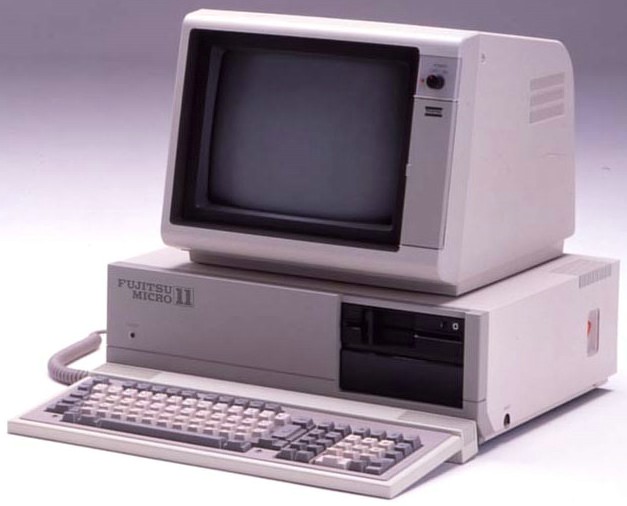
Fujitsu FM-11
Fujitsu FM-11
📅 1982🌍 Japon
Ficha técnica

Historia

The FM-11 was announced as a higher-end model of the FM-8 in November 1982, simultaneously with the mass market FM-7 machine. The FM-11 series was intended to be used in offices. FM stands for Fujitsu Micro.

Características

Lenguajes  	F-Basic available on disk
Teclado  	Complete professional Teclado with function Teclas and separated numeric keypad (JIS standard). 98 Teclas.
CPU  	Intel 8088 (8 Mhz) and MBL 68B09E (2 Mhz) (Motorola MC69B09s in earlier models)
Velocidad  	MBL69B09s (Video and I/O control)
Co-procesador  	Fujitsu MBL 69B09s
RAM  	128 KB (up to 1 MB)
VRAM  	192 KB
ROM  	24 KB
Modos de Texto  	40 x 20, 40 x 25, 80 x 20, 80 x 25
Modo gráfico  	640 x 400, 640 x 200 with 8 colours
Coloresc  	16
Sonido  	Beeper
Tamaño/Peso  	464 (W) x 360 (D) x 153 (H) mm / 11.8 Kg (13 Kg with addition floppy disk drive)
Puertos de entrada/salida  	Teclado, Light pen, Tape interface, Monochrome video output, Color video output, Printer (parallel/Centronics), RS-232C, 5 Slots de expansión
Almacenamiento interno  	1 or 2 x 5.25 disk drives (2DD, 320 KB)
OS  	CP/M 86, in option: OS-9, FLEX, MS-DOS and CP/M 80
Fuente de alimentación  	Built-in PSU
Precio  	398 000 yen (Japan, 1983)
Fujitsu FM-7
Fujitsu FM-7
📅 1982🌍 Japon
Ficha técnica

Historia

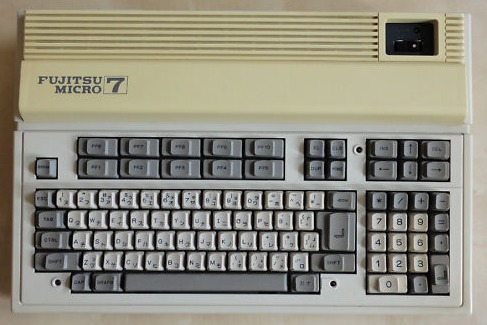
The FM-7 (Fujitsu Micro 7) is a home computer created by Fujitsu, first released in 1982, only sold in Japan. It is a stripped down version of their earlier FM-8; during development, the FM-7 was known as the FM-8 Jr.. Although it is known as a lower cost model, most notably removing its (expensive) bubble memory technology, the FM-7 was given a more advanced sound synthesizer, leading to a strong uptake among the hobbyist computer market in Japan and making it a more dominant system than the FM-8. This model competed primarily with the NEC PC-8801 and Sharp X1 series of computers in the early 1980s. It was succeeded by the FM-77 series in 1984 (which were backwards compatible with the FM-7), and later the 32-bit FM Towns in 1989. The FM-7 is 6809-based, similar to the TRS-80 Color Computer by Radio Shack; some software is compatible with both systems.

Características

Nombre 	FM 7
Fabricante  	Fujitsu
TYPE  	Home Computer
Origen  	Japan
Año  	November 1982
BUILT IN LANGUAGE  	FUJITSU F-BASIC Version 3.0
KEYBOARD  	Full-stroke 98 key with 10 function keys, arrow keys and numeric keypad.
CPU  	MBL 68B09
Velocidad  	2 MHz
Co-procesador  	second MBL 68B09 (Graphic & I/0)
RAM  	64 KB (30371 Bytes free with F-Basic)
VRAM  	48 KB
ROM  	48 KB
TEXT MODES  	80 x 25 / 80 x 20 / 40 x 25 / 40 x 20
Modo gráfico  	640 x 200 pixels
Colores  	8
Sonido  	Programable Sound Generator, 3 channels, 8 octaves
Tamaño/Peso  	43.2 (W) x 28.5 (D) x 10.2 (H)
Puertos de entrada/salida  	Tape, RGB, RS232, Joystick (2), ROM/RAM cartridges, BUS
BUILT IN Almacenamiento  	Optional 5.25 disk-drive. 10 or 20 MB hard disk
OS  	Fujitsu Disk Basic , OS-9 (Microware), Flex (CP/M like DOS for 68xx CPU)
Fuente de alimentación  	Built in Power supply AC100V 50/60Hz 70W
Perifericos  	Kanji ROM card, Z80 card, RS232c interface card, etc.
Precio  	£569 + £430 (Fujitsu monitor)
Fujitsu FM-New7
Fujitsu FM-New7
📅 1984🌍 Japon
Ficha técnica

Historia

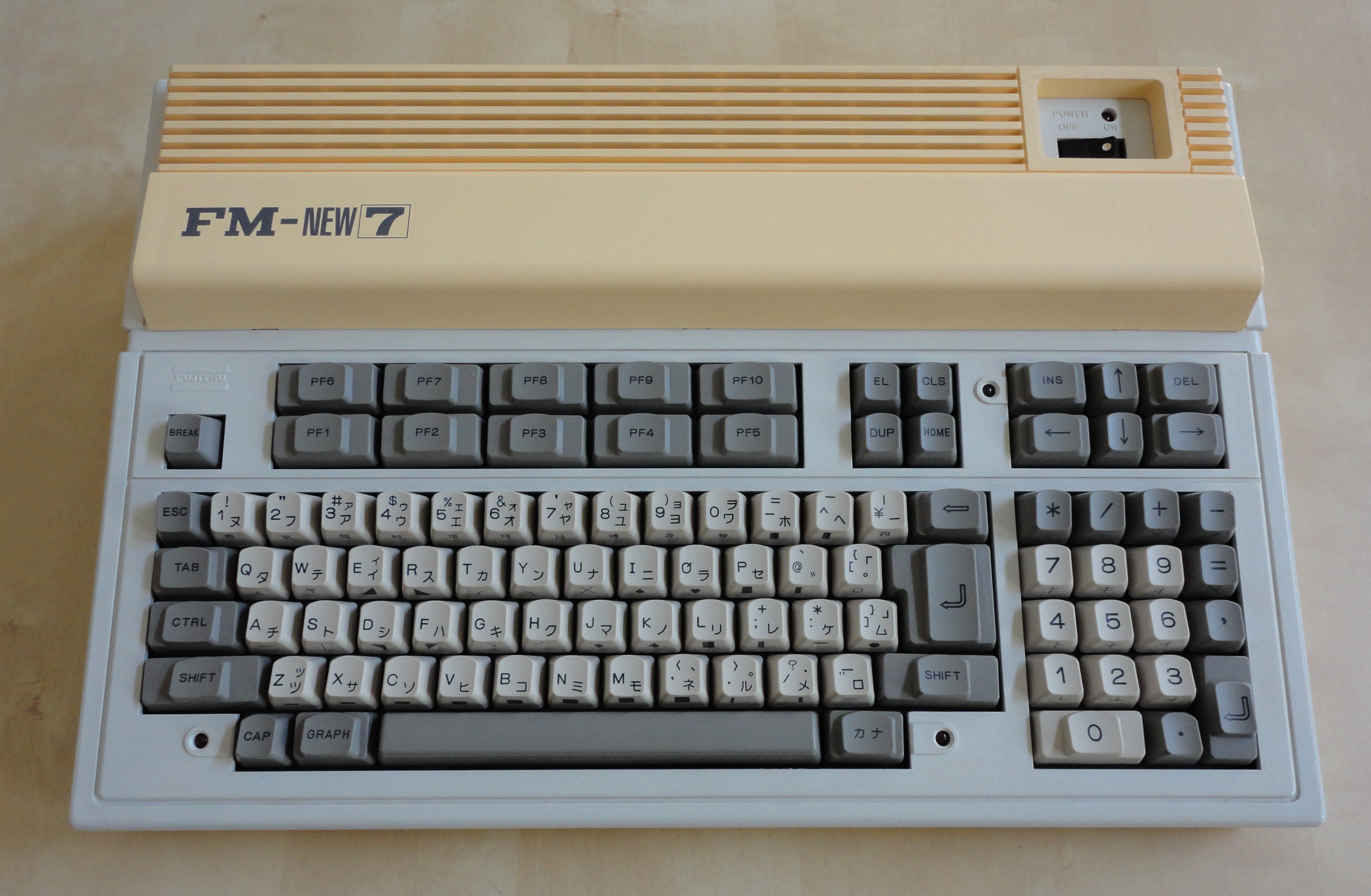
The FM-NEW7 as its name suggests is the successor of the FM-7. It uses high-integration memory and gate array LSI to reduce price while maintaining FM-7 functionality. But on the paper, there is no real difference between the FM-NEW7 and the old FM-7. The system is powered by two Motorola 68B09 micro-processors. One is the main CPU and the other handles video and inputs/outputs. There is a (optional?) Kanji (Chinese characters) ROM offering: 453 JIS non-kanji characters and 2965 JIS level 1 characters. Japanese text can be displayed on 40 columns x 12 lines. On the Japanese Computer Museum, one can read: Later, it developed into the FM-NEW7, which used high-integration memory and gate array LSI to reduce price while maintaining FM-7 functionality, and a high-end machine called the FM-77. From the start, the FM-7/77 series emphasized high-resolution color graphics and Japanese language display, and this trend continued with AV (Audio Visual) personal computers (beginning with the subsequent FM-77 AV) and the FM TOWNS hypermedia personal computer. The FM-7/77 machines laid the groundwork for Fujitsus later hobby machines.

Características

Lenguajes  	F-Basic
Teclado  	Full stroke QWERTY Teclado, 10 function Teclas, arrow Teclas
CPU  	Motorola 68B09
Velocidad  	2 MHz
Co-procesador  	second Motorola 68B09
RAM  	64 KB
VRAM  	48 KB
ROM  	44 KB
Modos de Texto  	40 x 12 (japanese language Pantalla)
Modo gráfico  	640 x 200 with 8 colours
Sonido  	3 channels, 8 octaves
OS  	with optional disk drives: OS-9, FLEX, UCSD-P SYSTEM, RUNSER and even CP/M with Z80 expansion board
Fuente de alimentación  	Built-in Fuente de alimentación
Precio  	99800 yen (Japan)
Secoinsa FM-7
Secoinsa FM-7
📅 1985🌍 Espana
Ficha técnica

Historia

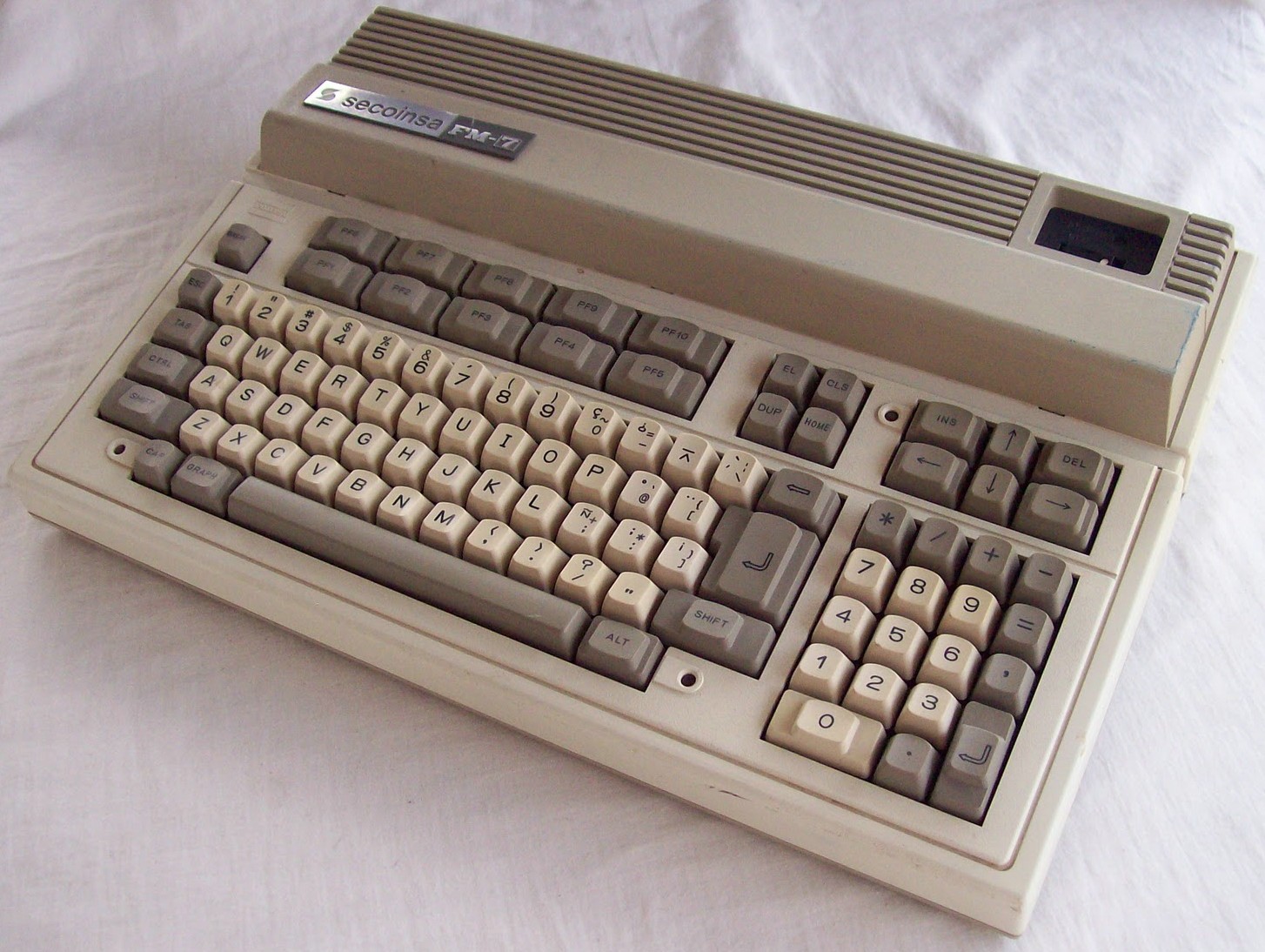
En España primeramente salió como un Secoinsa, bajo licencia Fujitsu. Luego comenzaron a aparecer ya como Fujitsu. Es un equipo que data de 1982 pero hasta el 85 no se empezaron a ver por España. Usualmente los consitorios que adquirian Secoinsa Series 20 y 40 para luego acabar en Oasis16 o Theos, solían recibir como regalo/complemento con la adquisición un par de FM7. Es de ahí de donde yo tuve contacto con el en su época. EL FM7 es el primer modelo de la gama FM de Fujitsu, gama cuyo ultimo modelo es el reciente FM Towns. Esta gama es muy popular en Japón, junto a los MSX, Nec PC y X68000. En España, el FM-7 se presenta, de la mano y marca de Secoinsa, como candidato al Proyecto Athenea de informatización de la enseñanza (similar al papel del BBC B en Inglaterra, pero nunca terminado). Su Aula Informatica permite conectar al puesto del profesor hasta 128 puestos, siendo 15 el numero ideal. He visto uno de ellos, pero no pude ver sus caracteristicas. Los 2 reportajes de que dispongo (publicados por Tu Micro y Micros) discrepan entre si: uno habla de 3 68B09 (CPU, teclado, video) y otro de 2. Uno de 32 Kb + 8 Kb de ROM y otro de solo 8 Kb (con el BASIC en 2 versiones). Uno de 56 Kb de VRAM y otro de 48 Kb. Uno de 540 x 200 en 8 colores, otro de 640 x 200 en 256 colores. Uno de sonido de serie y otro como opcion. Uno de perifericos en desarrollo, otro los prueba. Secoinsa fue un proveedor de Telefonica, hasta que acabó siendo absorbida por Fujitsu (que ya participaba la sociedad), dando lugar a Fujitsu España. Su departamento de I+D es vaciado tras la adquisición de ICL en Inglaterra En la parte inferior se encuentra un DIP switch con 4 interruptores que configura : 1 ROM : ON arranca en modo BASIC/Disco (con controladora de Floppys) / OFF arranca OS9 / Flex 2 DOS mode 3 ? 4 Frecuencias de las CPUs MAIN CPU SUB CPU 4=ON 1.2Mhz 1.0Mhz (FM-8 compatible mode) 4=OFF 2.0Mhz 2.0Mhz

Página 1 de 1