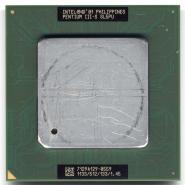
Intel Pentium III Tualatin
| Año | 2001 |
| Generación | 0 |
| Procesador | 7982 |
| Accesorio | modelos |
Historia
The third Pentium III-version, Tualatin, was really just a trial for Intels new 0.13 �m process. As the Pentium 4 had a much bigger die size than the Pentium III, Intel would get more usable Pentium IIIs out of a wafer, and this would allow them to introduce the 0.13 �m Pentium 4 (Northwood) once the process was achieving optimal yields. Tualatin performed quite well, especially in variations which had 512 KiB L2 cache (called the Pentium III-S). The Pentium III-S variant was mainly intended for servers, especially those where power consumption mattered, i.e., thin blade servers. Pentium III Tualatins were released during 2001 until early 2002 at speeds of 1.0, 1.13, 1.2, 1.26, 1.33 and 1.4 GHz. Intel did not want a repeat of the situation where the performance of a lower priced Celeron rivaled that of the more expensive Pentium II, so Tualatin never ran faster than 1.4 GHz, the introductory clock rate of the Pentium 4. Overclockers discovered as well that 1.4-1.5 GHz with air-cooled temperatures was reaching the limits of the process and so Intel may have also wanted to avoid sacrificing profits with lower yields of a faster chip. The Tualatin core was named after the Tualatin Valley and Tualatin River in the Oregon area. Tualatins can be visually distinguished from Coppermine-based Pentium IIIs by the metal heatspreader fixed on top of the package.